PHONE
+86-18680257330

+8618680257330
ADD
Dongguan, Guangdong Province
- All
- Product Name
- Product Keyword
- Product Model
- Product Summary
- Product Description
- Multi Field Search
Views: 0 Author: Eric Wu From GORUN SCREW Publish Time: 2025-12-21 Origin: Site

Customers familiar with GORUN SCREW know that we are a factory specializing in the customization of self-tapping screws, self-drilling screws, and other fastener accessories.
Located in Dongguan, Guangdong Province, GORUN is equipped with advanced production equipment and a professional technical team. We are dedicated to providing customers with high-strength, high-precision fastening solutions. Our products are widely used in construction, automotive, electronics, and home appliance industries.
Our screw products are utilized for roof installations, metal wall installations, and structural assemblies involving metal or wood. Particularly in outdoor applications, they offer excellent corrosion resistance and structural stability. We utilize high-quality raw materials and precision manufacturing processes to ensure every batch meets the stringent requirements of our customers for strength and durability. For different application scenarios, we can provide customized head designs, thread specifications, and surface treatment solutions to comprehensively enhance assembly efficiency and connection reliability.
Beyond the aforementioned applications, many factories also commission GORUN to customize self-tapping screws for smart device casings, precision instruments, and small power tools. In these cases, screws are frequently assembled into plastic components. During the screw assembly process for plastic parts, improper torque control can easily lead to issues such as stripped threads or cracking in the plastic components. Therefore, we recommend that customers consider hole diameter fit and wall thickness strength during the design phase. In other words, product designers must pay attention to the compatibility between the plastic housing/accessories and the self-tapping screws during the design and production of the plastic parts themselves, avoiding assembly failures caused by overly brittle materials or unreasonable structures.
We recommend prioritizing engineering plastics with better toughness and ensuring the precise matching of the self-tapping screw thread profile with the plastic hole to evenly disperse torque. Meanwhile, the tightening speed should be controlled during assembly to avoid stress concentration caused by excessive instantaneous torque, which could damage the plastic part and lead to failure.
Based on our extensive experience collaborating with customers, GORUN has summarized the following content for your reference.
Excessive Assembly Torque
Cause: The tightening torque exceeds the load-bearing limit of the plastic and the screw. The plastic matrix produces cracks due to excessive stress.
Countermeasures: Determine a reasonable process torque range through Design of Experiments (DOE). Workers performing manual assembly should receive adequate training before taking their posts. Alternatively, use dedicated electric screwdrivers with a set torque limit to avoid over-torquing due to human error.
The diameter of the screw installation hole is too large
Cause: If the installation hole diameter is too large, the screw cannot form effective thread engagement after being driven in. This easily leads to stripped threads and loosening. This usually originates from worn injection molds or initial hole diameter design errors.
Countermeasures: Replace worn molds and calibrate the hole diameter to 85%~90% of the screw root diameter.
Note: Do not be overly conservative by designing the installation hole too small, as this will cause stress concentration during assembly and increase the risk of cracking. Ensure the hole diameter is reasonably matched to the self-tapping thread to improve assembly yield and structural reliability.
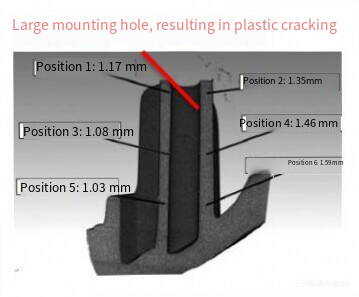
Low Plastic Part Strength
Cause: The plastic material itself has insufficient strength or a low content of reinforcing agents. The torque applied during tightening exceeds the maximum strength the plastic material can actually bear, causing plastic deformation and thread failure.
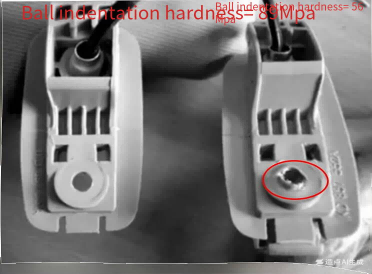
Pores in the Plastic Part
Cause: Poor fusion or inadequate venting during the injection molding process leads to tiny pores in the hole wall. When force is applied, stress concentrates at these pores, triggering cracks or a reduction in thread strength.
Countermeasures: Optimize the injection molding process and add venting grooves. Conduct spot checks before assembly to screen out defective parts. Products with pores exceeding the standard must not be used.
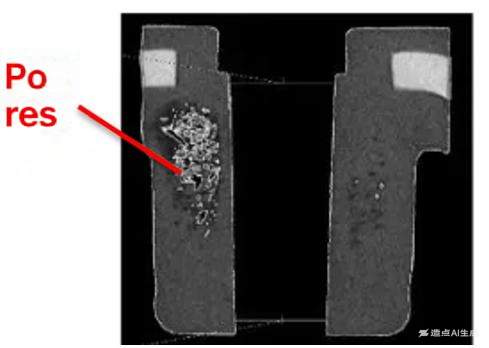
Thin Installation Hole Wall
Cause: The hole wall thickness is less than 1.5 times the screw diameter. When tightened, the plastic is subjected to forces exceeding its load-bearing limit, easily resulting in cracks or even breakage. This is mostly caused by unreasonable structural design of the plastic part.
Countermeasures: Optimize the structural design to increase the wall thickness to the standard value. Use screws with fine threads to disperse stress and reduce local load.
Note: While increasing wall thickness will raise product costs, reasonable design can significantly reduce the defect rate. Lowering assembly failure risks helps control overall costs in the long run.
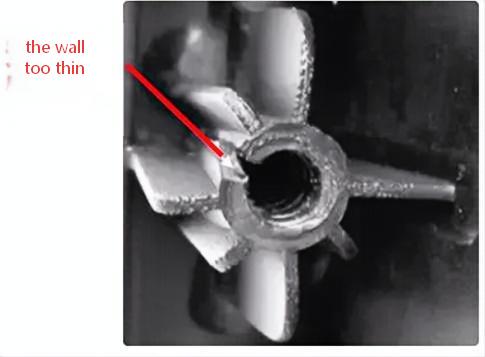
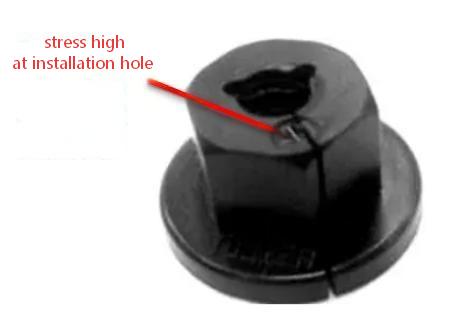
High Local Stress at the Installation Hole
Cause: The hole is located near the edge, corner, or rib junction of the plastic part, where stress concentration naturally exists. Tightening exacerbates this stress, leading to cracking.
Countermeasures: Move the hole position to an area with dispersed stress. The distance between the hole and the edge should be no less than 2 times the screw diameter. Chamfer the hole opening at 15°-30° to guide force distribution.
Moisture Content of the Plastic
Cause: Excessive moisture content in the plastic leads to micro-gaps inside after molding. Furthermore, moisture reduces material strength, making the hole wall prone to chipping during tightening. Hygroscopic plastics, such as PA (Nylon), are particularly significantly affected.
Countermeasures: Dry the plastic parts before assembly. Ensure moisture-proof sealing during storage and strictly control environmental temperature and humidity.
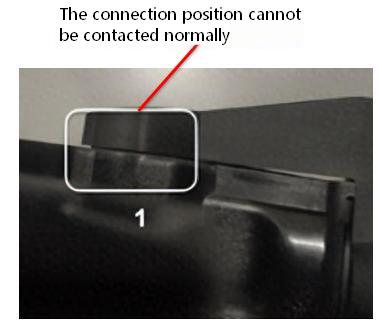
Poor Mating of Plastic Connection
After the self-tapping screw is tightened is another common issue.The screws failure to sit flush against the substrate, presence of gaps, or looseness. It can easily trigger abnormal noises, vibrations, or even component detachment.
Cause: This mainly includes insufficient assembly torque, undersized connected part holes, oversized screws, high material strength and hardness of the plastic part, and low moisture content in nylon-type plastics.
In short, the screw has not penetrated to the preset position, resulting in the screw head failing to press tightly against the substrate.
Countermeasures:
Set the appropriate assembly torque according to specifications to avoid floating screws due to insufficient torque.
Correct the diameter deviation between the connected part hole and the screw to ensure dimensional matching.
Select specialized self-tapping screws suitable for high-hardness plastics or appropriately adjust the plastic part's hardness.
Ensure nylon-type plastics have the appropriate moisture content before assembly.
From the summarized factors above, when plastic parts experience screw assembly failure, designers must fully consider the design of both the screw and the plastic product itself. Only by comprehensively analyzing the causes of screw assembly failure can we effectively prevent the recurrence of similar issues.
When customizing screws for customers, GORUN SCREW relies on customer-provided drawings, samples, or manufacturing standards. We provide not only OEM services but also ODM services. However, we require full cooperation from the client during the design process. Only through deep collaboration between both parties regarding material characteristics, structural design, and process parameters can the optimization of the connection solution be achieved.


